

When the European Commission’s Joint Research Centre gathered agricultural officials from across the bloc in Ispra last February, the message was clear: satellite data and AI are rewriting the rules of how Europe tracks its farmland — and the countries that adapt fastest will shape what comes next.
The 2nd FIRE Workshop, held on 25–26 February 2026, pulled in representatives from EU Member States, the European Commission, and partner organizations for two days of hard talk about where agricultural monitoring stands today and where it needs to go. On the table: the Area Monitoring System, the Land Parcel Identification System, and the growing stack of technologies being pushed into service under the Common Agricultural Policy.
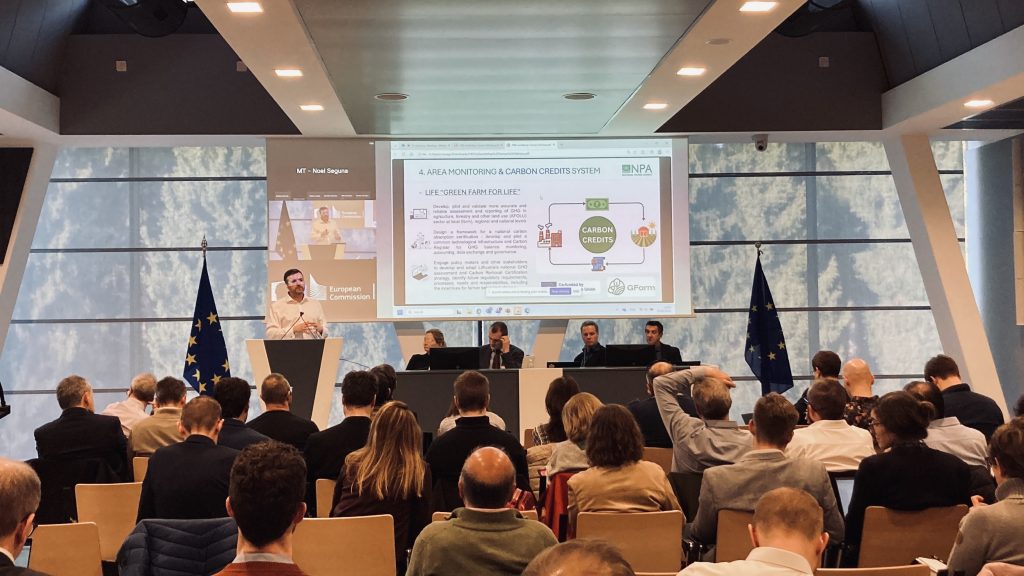
Lithuania didn’t come to listen. Tomas Orlickas, Deputy Director of the country’s National Paying Agency, took the floor with a presentation that laid out his country’s post-2027 strategy — and made the case that international research collaboration, not bureaucratic process, is what’s actually driving progress.
The Core Problem No One Wants to Admit
Getting the AMS to actually work at scale is harder than the policy documents suggest. The workshop spent considerable time reviewing survey results that spelled out where current monitoring practices are falling short — data quality gaps, outlier noise in Sentinel satellite time series, crop detection models that aren’t yet reliable enough for high-stakes decisions.
The Netherlands offered a rare success story, presenting its AMS deployment as a working model others could learn from. But the broader picture was one of systems still being stress-tested in the field, with fixes being developed in real time.
Experts presented new methodologies for scrubbing satellite data, next-generation crop detection models, and approaches for keeping the LPIS current by feeding in geotagged ground-level data. AI integration for continuous aerial imagery updates featured heavily — not as a future aspiration, but as something already in active deployment.
Lithuania’s Bet on Collaboration
Orlickas’s presentation, titled “What’s Next after AMS? Strategy of Lithuania post-2027,” was one of the more concrete things on the agenda. Rather than outlining ambitions, it showed receipts — how Lithuania has been using Horizon Europe, Horizon 2020, and other EU-funded platforms to build out genuine monitoring capability.
The projects cover ground that goes well beyond basic compliance: climate impact assessment in agriculture, biodiversity tracking tools, and carbon accounting frameworks that can actually hold up to third-party verification. The argument Orlickas made, implicitly and explicitly, was that the next generation of monitoring infrastructure won’t be built by individual member states working alone.
Carbon Farming Gets a Real Tool
One project got particular attention: GFarm for LIFE, funded through the EU LIFE programme. The initiative is focused squarely on greenhouse gas emissions reporting across agriculture, forestry, and land use — a reporting obligation that has historically been more aspiration than precision.
What makes it notable is the practical angle. Beyond policy support and scientific rigor, the project is designed to give farmers a path to carbon credit income — third-party verifiable certification that could translate directly into supplementary revenue. That’s a different pitch than most EU environmental initiatives, which tend to lead with compliance obligations rather than economic opportunity.
Drones, Candidate Countries, and the Bigger Picture
The workshop’s final stretch covered support for EU candidate countries building their LPIS from scratch, a series of rapid-fire tool demonstrations — crop phenology trackers, farm fragmentation analysis, parcel visualization applications — and a notable session on drone monitoring.
A Czech Republic use case and JRC field test results made the practical argument for drones: where satellites give you coverage, drones give you resolution. The two aren’t competing; they’re complementary, and the gap between what’s theoretically possible and what’s operationally deployed is closing faster than expected.
The overarching conclusion of the workshop was straightforward: the technology exists, the policy framework is evolving, and the limiting factor now is whether institutions — national agencies, research bodies, and the Commission itself — can coordinate well enough to actually use it.
Lithuania, for one, appears to be taking that challenge seriously.