

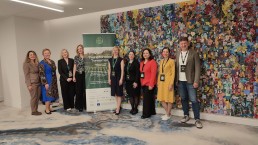
Bridging Innovation Across Agriculture, Forestry, and Energy Fields: A Look Back at Two Days Well Spent
On May 5 and 6, 2026, Vilnius hosted one of the most substantive cross-sector gatherings in recent Lithuanian agrifood memory. Here is what happened, who was there, and why it mattered.
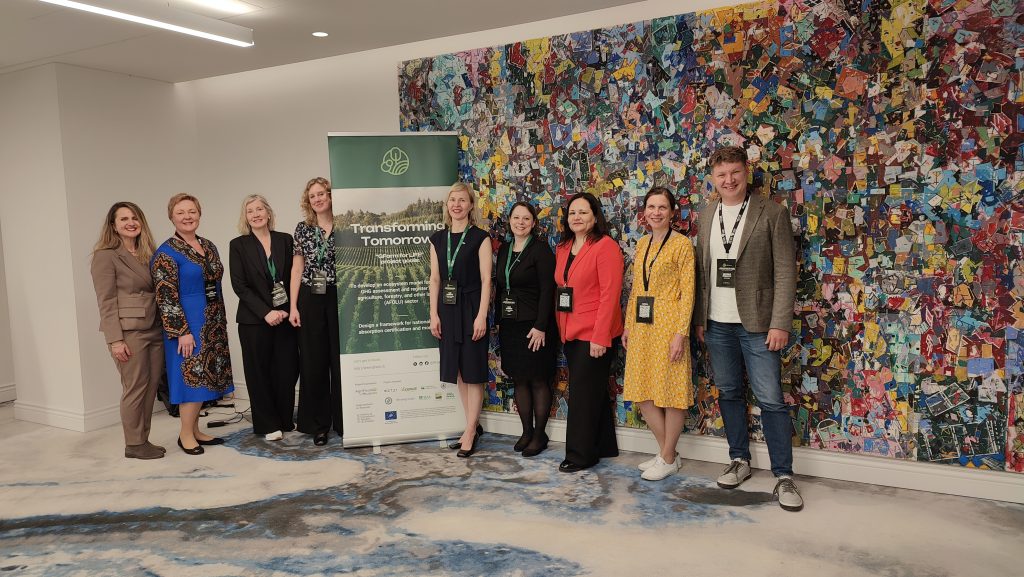
There are conferences where people talk about change, and there are conferences where people who are actually making it happen sit down together. The two-day event held at the Pacai Conference Hall on May 5th and at Mokslininkų str. 2A on May 6th was firmly the latter.
Organised by GFarm in collaboration with the Forest 4.0 project and hosted by Agrifood Lithuania, the conference brought together policymakers, researchers, industry practitioners, and EU representatives under one clear ambition: to move beyond sectoral thinking and find practical, scalable pathways toward climate-neutral land use systems.
Day 1: From Policy to Practice
The morning opened with welcoming remarks from Kristina Šermukšnytė-Alešiūnienė, Chief Executive of Agrifood Lithuania, before Hana Mandelíková, Project Officer at CINEA, set the European context by outlining the priorities and funding opportunities under the LIFE Programme. It was a timely reminder that the work happening in Lithuanian fields and forests does not exist in isolation. It is part of a much larger European effort.
Dr. Alina Butu from Romania's National Institute of Research and Development for Biological Sciences followed with a presentation on advancing cross-sector solutions for climate-neutral land use, before the floor opened to one of the day's most anticipated sessions: a panel discussion on enabling cross-sector synergies across agriculture, forestry, and energy. The panel brought together Dr. Audronė Ispiryan from Vytautas Magnus University, Remigijus Lapinskas of the Green Policy Institute, Agnė Bagočiūtė from the Lithuanian Energy Agency, and Dr. Marius Aleinikovas from the Lithuanian Research Centre for Agriculture and Forestry. The discussion was moderated by Dr. Alina Butu and covered governance, regulatory frameworks, and the institutional conditions needed to make real integration possible.
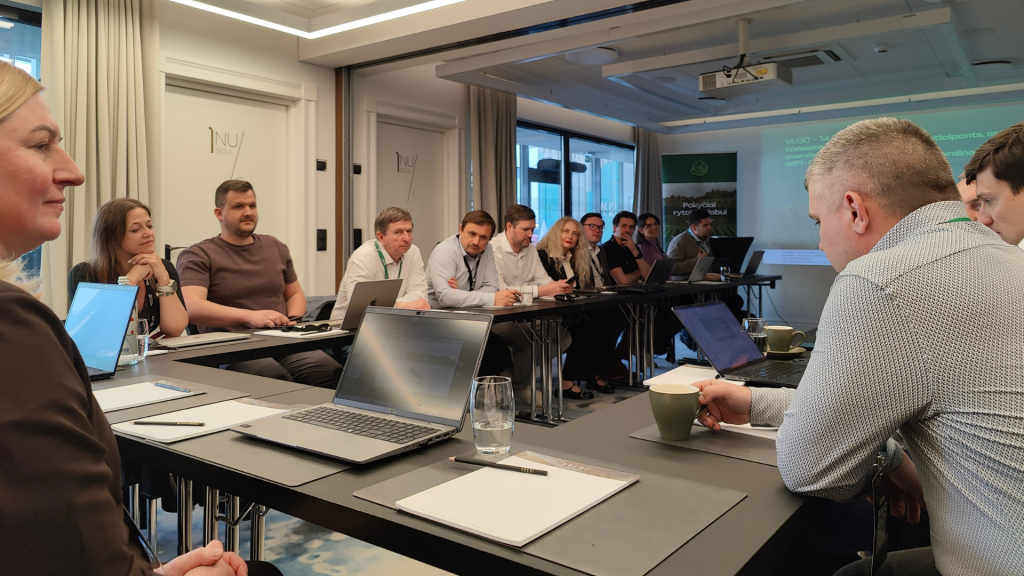
After a coffee break, Romualdas Lapickis of AFL presented the results of the GFarm project itself, walking the room through the tools developed, the data gathered, and the honest lessons learned from years of carbon farming implementation on the ground. It was one of the most grounded presentations of the day.
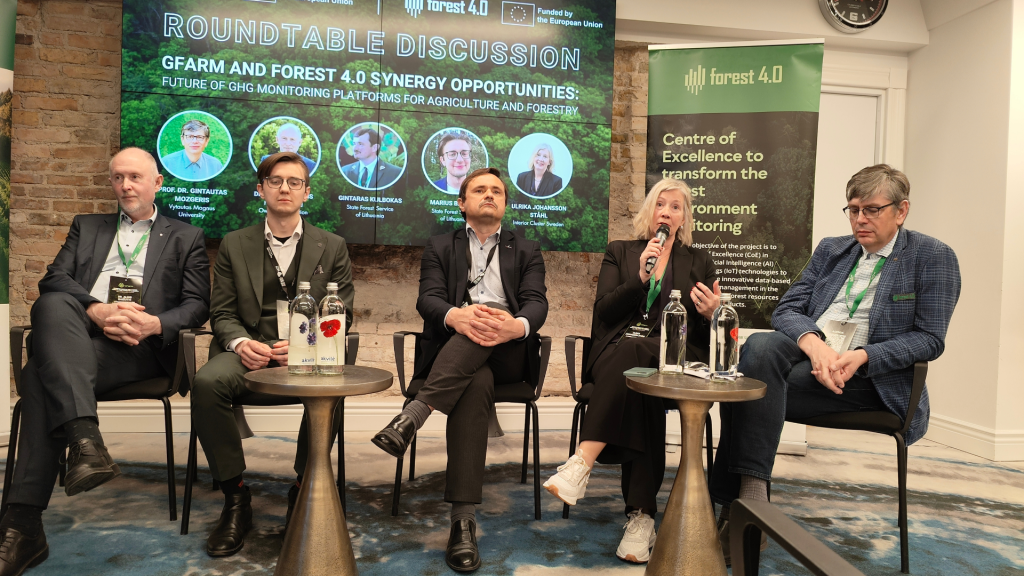
That was followed by a roundtable on the synergy opportunities between GFarm and Forest 4.0, specifically on the future of shared GHG monitoring platforms for agriculture and forestry. The roundtable featured Prof. Dr. Gintautas Mozgeris from Vytautas Magnus University, Dr. Algis Gaižutis from FAOL, Gintaras Kulbokas and Marius Balčius from the State Forest Service of Lithuania, and Ulrika Johansson Ståhl from Interior Cluster Sweden. The conversation was candid and forward-looking, examining how interoperable digital tools can serve both sectors rather than duplicating effort.
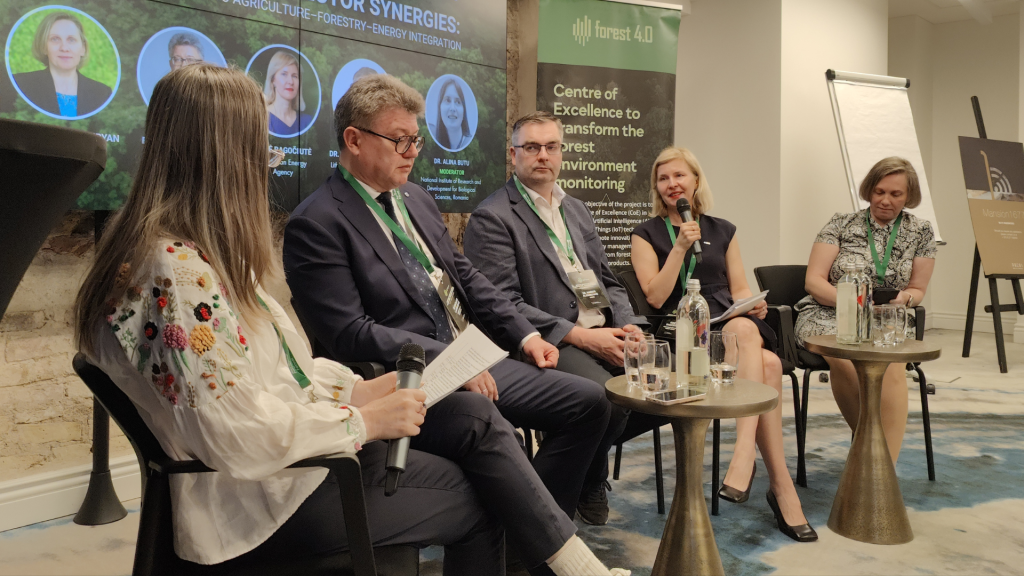
Dr. Audronė Ispiryan closed the pre-lunch session with a presentation on agroecological orchard systems integrating biodiversity, sustainability, and socio-economic value.
The afternoon shifted toward energy. Agnė Stonienė, Acting Director of the Energy Efficiency Competence Center, opened with a focused look at how energy efficiency translates directly into competitiveness for farmers. This fed into a broader panel discussion on driving the energy transition in rural systems, featuring Jolanta Zubkauskienė from the Lithuanian Innovation Center, Rolandas Dockevičius, an expert in additive manufacturing and electric propulsion, and Audronė Janulaitytė, Acting Head of the GreenTech Hub at the Innovation Agency. The afternoon made clear that renewable energy in farming is no longer a future conversation. It is a present one.
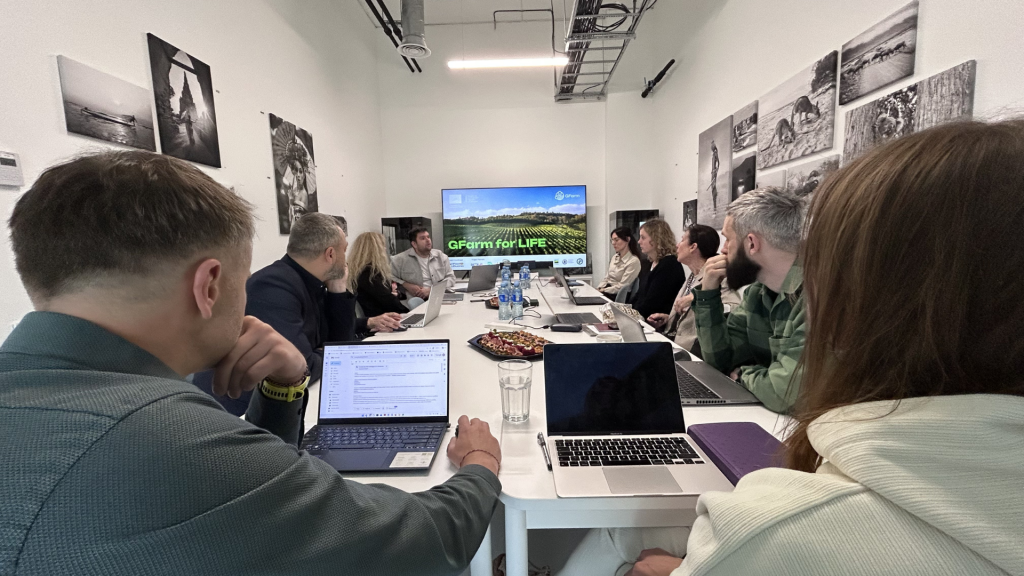
Parallel to the afternoon programme, the official GFarm Final Monitoring Visit began with Aušra Palubinskienė from ELMEN and Hana Mandelíková from CINEA. A milestone moment for the project and everyone who has contributed to it.
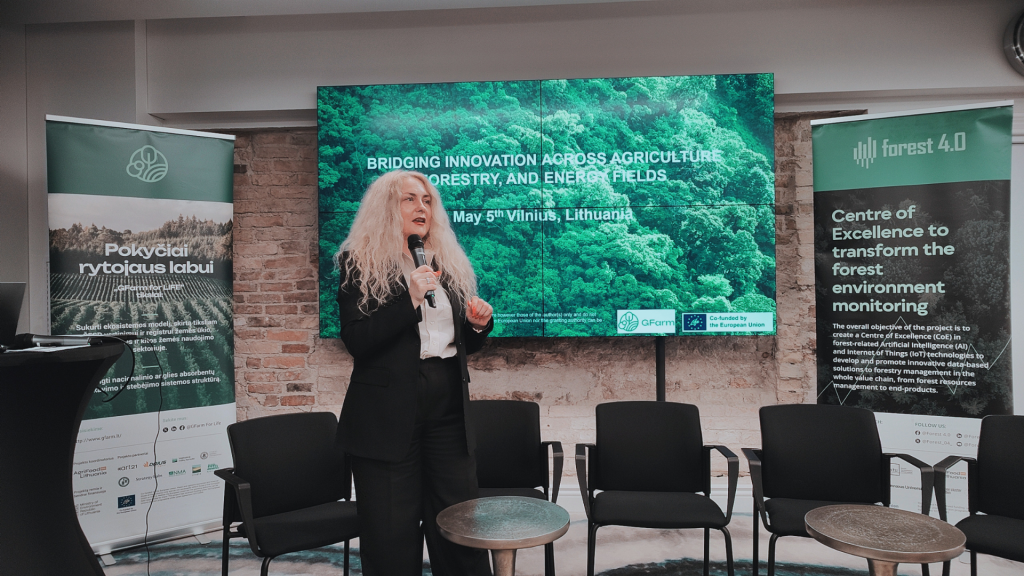
Day 2: Reflection and Review
The second day was dedicated entirely to the GFarm consortium's internal review. Partners gathered to go through the project's achievements in detail, assess its real-world impact, and discuss what the past years of implementation have genuinely taught them. These are the conversations that rarely make it into press releases but are essential for any project that wants its results to matter beyond its own lifetime.
What the Two Days Left Behind
The outcomes of the conference go beyond the notes taken and the presentations delivered. Across two days, the discussions produced clearer alignment between EU policy objectives and what practitioners actually need on the ground, concrete ideas for scaling cross-sector solutions, and a stronger network of people who now know each other by name rather than just by institution.
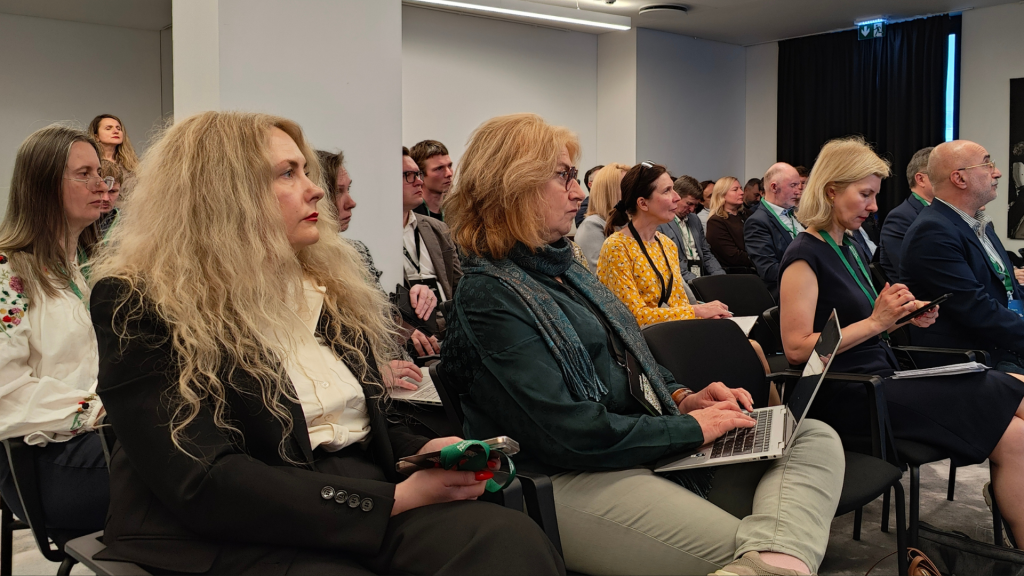
Perhaps most importantly, the event reinforced something GFarm has been demonstrating for years: that Lithuania has the people, the expertise, and the ambition to be a genuine European reference point for integrated, climate-smart land use.
Thank you to every speaker, partner, moderator, and participant who made these two days what they were.


Bridging Innovation Across Agriculture, Forestry, and Energy Fields
Bridging Innovation Across Agriculture, Forestry, and Energy Fields
May 5th, 2026, Vilnius
Address: Didžioji str. 7, Pacai conference hall
Day 1
|
Registration & Welcome Coffee |
All | 8:30–9:00 |
|
Opening session: Welcome remarks |
Kristina Šermukšnytė-Alešiūnienė, Agrifood Lithuania CEO | 9:00–9:15 |
|
EU Policy, Priorities and Funding Opportunities in LIFE Programme |
Hana Mandelikova, Project Officer, CINEA | 9:15–9:30 |
|
Advancing Cross-Sector Solutions for Climate-Neutral Land Use Systems |
dr.Alina Butu, National Institute of Research and Development for Biological Sciences | 9:30-9:40 |
|
Panel discussion: Enabling Cross-Sector Synergies: Policy Approaches to Agriculture–Forestry–Energy Integration |
1. Dr. Audronė Ispiryan, Vytautas Magnus University
2. Remigijus Lapinskas, Head of Green Policy Institute 4. Dr. Marius Aleinikovas, Deputy Director for Institute of Forestry Activities at Lithuanian Research Centre for Agriculture and Forestry |
9:40–11:00 |
|
Coffee break |
11:00–11:30 | |
|
Carbon Farming in Practice: Tools, Results, and Lessons Learned from GFarm |
Romualdas Lapickis, AFL | 11:30–11:40 |
|
Roundtable discussion: GFarm and FOREST 4.0 Synergy Opportunities: Future of GHG Monitoring Platforms for Agriculture and Forestry |
1. Prof. dr. Gintautas Mozgeris, Vytautas Magnus University
2. Dr. Algis Gaižutis, director at FAOL 3. Gintaras Kulbokas, Head of the Department at State Forest Service of Lithuania 4. Marius Balčius, Sr. Specialist at State Forest Service of Lithuania 5. Ulrika Johansson Ståhl, Project Manager at Interior Cluster Sweden |
11:40– 12:50 |
|
Agroecological Orchard Systems Integrating Biodiversity, Sustainability, and Socio-Economic Value |
dr.Audronė Ispiryan, Vytautas Magnus University | 12:50-13:00 |
|
Lunch break |
13:00 – 14:00 | |
|
Energy Efficiency: Lower Costs – Greater Opportunities for Competitiveness |
1. Agnė Stonienė, Acting Director of the Energy Efficiency Competence Center | 14:00 – 14:10 |
|
BioSolFarm: Advancing Green Energy Solutions in Agriculture through Innovation, Support, and Policy |
1. Agnė Stonienė, Acting Director of the Energy Efficiency Competence Center at Lithuanian Energy Agency 2. Jolanta Zubkauskienė, Lithuanian Innovation Center, project manager Expert in additive manufacturing, electric propulsion and recyclability (BioSolFarm co-partner) 4. Audronė Janulaitytė, Innovation Agency, Acting Head of GreenTech Hub Moderator: Dr. Virginijus Radziukynas, Vice-President of the Lithuanian Confederation of Industrialists (LPK), Senior Researcher at the Lithuanian Energy Institute (LEI), Smart Grids and Renewable Energy Laboratory |
14:10-15:30 |
| GFarm Final Monitoring Visit and Project Review |
14:00 – 17:00 |
|
Bridging Innovation Across Agriculture, Forestry, and Energy Fields
May 6h, 2026, Vilnius, Lithuania
Address: Mokslininkų str. 2A, Vilnius
Day 2
|
Registration & Welcome Coffee |
All | 8:30–9:00 |
|
GFarm Final Monitoring Visit and Project Review |
Gfarm consortium | 9:00–13:00 |
|
Lunch break |
13:00–14:00 | |
Bridging Innovation Across Agriculture, Forestry, and Energy Fields
May 5–6, 2026 | Vilnius, Lithuania | Pacai Conference Hall
This event brings together policymakers, industry leaders, researchers, and innovation actors to explore how stronger integration across agriculture, forestry, and energy systems can accelerate Europe’s transition towards climate neutrality, resilience, and sustainable competitiveness.
The programme is designed to move beyond sectoral silos and focus on practical pathways for cross-sector collaboration, highlighting how policy frameworks, digital technologies, and investment strategies can jointly enable systemic transformation. Special attention is given to aligning EU priorities—particularly under the LIFE Programme—with real implementation needs at regional and value chain levels.
The first day focuses on policy, innovation, and applied solutions. High-level discussions will address the enabling conditions for cross-sector integration, including governance, regulatory frameworks, and institutional cooperation. This is complemented by practical insights into carbon farming, digital monitoring systems, and sustainable forest management, demonstrating how data-driven approaches can support climate action and resource efficiency.
Interactive roundtables will foster dialogue on shared monitoring systems, greenhouse gas accounting, and interoperability of digital tools, aiming to identify scalable solutions that work across both agricultural and forestry contexts. The afternoon sessions will shift towards energy transition in rural systems, exploring how renewable energy deployment, energy efficiency measures, and circular approaches can be embedded into farming and land-use practices.
The second day is dedicated to project-level reflection and validation, creating space for in-depth discussion among partners and stakeholders about achieved results, lessons learned, and the potential for future replication.
Expected Outcomes
- Strengthened alignment between EU policy objectives and on-the-ground implementation
- Identification of scalable cross-sector solutions for climate mitigation and resource efficiency
- Enhanced cooperation between agriculture, forestry, and energy stakeholders
- Clear recommendations for policy, investment, and innovation support mechanisms
- Concrete opportunities for replication and follow-up collaboration at the national and EU levels
The event aims to position Lithuania as a hub for integrated, cross-sector innovation in agrifood, forestry, and energy, contributing to broader European efforts towards a resilient and climate-neutral future.
Bridging Innovation Across Agriculture, Forestry & Energy
A landmark conference in Vilnius will bring together scientists, policymakers, and innovators to showcase GFarm — a project redefining how greenhouse gases are tracked across agriculture and forestry.
When researchers at Lithuania's leading agricultural institutions set out to build a unified monitoring system for greenhouse gas emissions across farmland and forests, few anticipated the scale of collaboration it would require. Now, after years of development, the GFarm project is preparing to present its findings to the world — and the timing could not be more consequential.
On May 5 and 6, Vilnius will host "Bridging Innovation Across Agriculture, Forestry, and Energy Fields," a two-day conference at the Pacai Conference Hall that will convene policymakers, researchers, and industry leaders from across Europe. The event, co-funded by the European Union under the LIFE Programme, marks the final monitoring review of the GFarm project and doubles as a broader forum on cross-sector strategies for climate action.
Central to the first day's programme is a presentation by Romualdas Lapickis, who will walk attendees through the practical lessons of GFarm: what tools were built, what results were achieved, and what the project's architects would do differently. That session will be followed by a roundtable examining how GFarm's monitoring platform might be harmonised with the parallel FOREST 4.0 initiative, co-chaired by leading voices from Vytautas Magnus University, the State Forest Service of Lithuania, and Sweden's Interior Cluster.
The agenda opens with remarks from Kristina Šermukšnytė-Alešiūnienė, Chief Executive of Agrifood Lithuania, before shifting to the policy landscape. Hana Mandelikova, a Project Officer at CINEA — the European Climate, Infrastructure and Environment Executive Agency — will outline EU priorities and funding opportunities under the LIFE Programme, the primary mechanism through which Brussels channels investment into nature and climate projects.
The afternoon sessions pivot toward energy. Agnė Stonienė, Acting Director of the Energy Efficiency Competence Center, will present on the economics of efficiency — framing lower energy costs not merely as a savings measure but as a competitive lever for Lithuanian farmers. Her presentation leads into a broader panel on how renewable energy deployment and circular approaches can be embedded directly into farming practices.
The second day is reserved for internal reflection. GFarm's consortium partners will gather at a separate venue on Mokslininkų Street for a closed project review — a reckoning with what was built, what was learned, and how the model might be replicated elsewhere in Europe.
Organisers say they hope the conference will position Lithuania as a model for integrated, cross-sector climate innovation — a small country that has quietly assembled the tools and partnerships to punch well above its weight in the European green transition.
Join us in Vilnius
Whether you work in agriculture, forestry, energy, or policy — this is your opportunity to be part of a conversation that is shaping the future of Europe's climate strategy. Connect with leading researchers, practitioners, and decision-makers, and see firsthand what years of cross-sector collaboration have made possible.
May 5–6, 2026
Day 1: Pacai Conference Hall, Didžioji str. 7, Vilnius
Day 2: Mokslininkų str. 2A, Vilnius
The Strengthening of Agricultural Monitoring through Innovation and International Cooperation: A Comprehensive Report on the JRC FIRE Workshop
When the European Commission's Joint Research Centre gathered agricultural officials from across the bloc in Ispra last February, the message was clear: satellite data and AI are rewriting the rules of how Europe tracks its farmland — and the countries that adapt fastest will shape what comes next.
The 2nd FIRE Workshop, held on 25–26 February 2026, pulled in representatives from EU Member States, the European Commission, and partner organizations for two days of hard talk about where agricultural monitoring stands today and where it needs to go. On the table: the Area Monitoring System, the Land Parcel Identification System, and the growing stack of technologies being pushed into service under the Common Agricultural Policy.
Lithuania didn't come to listen. Tomas Orlickas, Deputy Director of the country's National Paying Agency, took the floor with a presentation that laid out his country's post-2027 strategy — and made the case that international research collaboration, not bureaucratic process, is what's actually driving progress.
The Core Problem No One Wants to Admit
Getting the AMS to actually work at scale is harder than the policy documents suggest. The workshop spent considerable time reviewing survey results that spelled out where current monitoring practices are falling short — data quality gaps, outlier noise in Sentinel satellite time series, crop detection models that aren't yet reliable enough for high-stakes decisions.
The Netherlands offered a rare success story, presenting its AMS deployment as a working model others could learn from. But the broader picture was one of systems still being stress-tested in the field, with fixes being developed in real time.
Experts presented new methodologies for scrubbing satellite data, next-generation crop detection models, and approaches for keeping the LPIS current by feeding in geotagged ground-level data. AI integration for continuous aerial imagery updates featured heavily — not as a future aspiration, but as something already in active deployment.
Lithuania's Bet on Collaboration
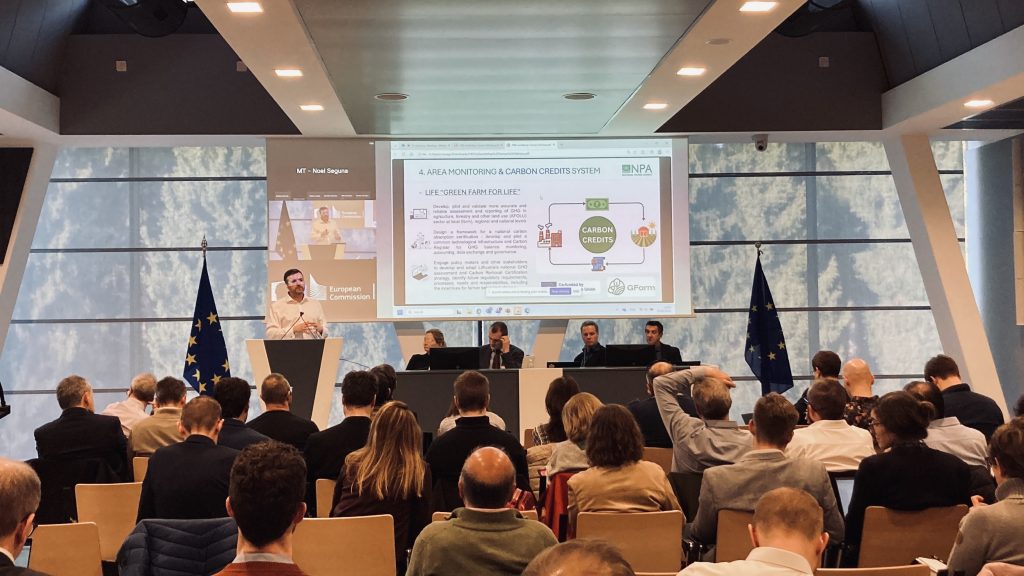
Orlickas's presentation, titled "What's Next after AMS? Strategy of Lithuania post-2027," was one of the more concrete things on the agenda. Rather than outlining ambitions, it showed receipts — how Lithuania has been using Horizon Europe, Horizon 2020, and other EU-funded platforms to build out genuine monitoring capability.
The projects cover ground that goes well beyond basic compliance: climate impact assessment in agriculture, biodiversity tracking tools, and carbon accounting frameworks that can actually hold up to third-party verification. The argument Orlickas made, implicitly and explicitly, was that the next generation of monitoring infrastructure won't be built by individual member states working alone.
Carbon Farming Gets a Real Tool
One project got particular attention: GFarm for LIFE, funded through the EU LIFE programme. The initiative is focused squarely on greenhouse gas emissions reporting across agriculture, forestry, and land use — a reporting obligation that has historically been more aspiration than precision.
What makes it notable is the practical angle. Beyond policy support and scientific rigor, the project is designed to give farmers a path to carbon credit income — third-party verifiable certification that could translate directly into supplementary revenue. That's a different pitch than most EU environmental initiatives, which tend to lead with compliance obligations rather than economic opportunity.
Drones, Candidate Countries, and the Bigger Picture
The workshop's final stretch covered support for EU candidate countries building their LPIS from scratch, a series of rapid-fire tool demonstrations — crop phenology trackers, farm fragmentation analysis, parcel visualization applications — and a notable session on drone monitoring.
A Czech Republic use case and JRC field test results made the practical argument for drones: where satellites give you coverage, drones give you resolution. The two aren't competing; they're complementary, and the gap between what's theoretically possible and what's operationally deployed is closing faster than expected.
The overarching conclusion of the workshop was straightforward: the technology exists, the policy framework is evolving, and the limiting factor now is whether institutions — national agencies, research bodies, and the Commission itself — can coordinate well enough to actually use it.
Lithuania, for one, appears to be taking that challenge seriously.
Lithuania showcases innovation and green transition at the 58 EU PA Directors’ Conference in Copenhagen
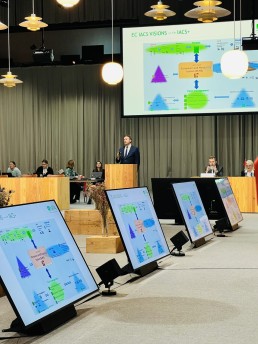
The 58th Conference of EU Paying Agencies Directors took place in Copenhagen, Denmark, on 19–21 November 2025, bringing together the EU Paying Agencies’ senior representatives to discuss innovation, simplification, data governance, and the evolving role of AI in implementing the Common Agricultural Policy (CAP) as well as the future direction of the CAP development, with a strong focus on interoperability, AI applications, and green transition. The representative of the Lithuanian National Paying Agency (NPA) – Deputy Director Tomas Orlickas – took part in the event and familiarised the audience with the NPA achievements in carrying out the multiple objectives of the CAP in Lithuania.
The sessions of the 58th Conference of EU Paying Agencies’ Directors focused on several key themes, including:
• The use of AI in the administration of support schemes;
• Administrative simplification and improved institutional efficiency;
• Modernisation of processes and advancing the green transition in the agricultural sector.
Over three days, delegates engaged in high-level presentations, thematic workshops, pitches and exchanges on best practices – particularly on AI applications, administrative simplification, aerial monitoring, and performance audit findings.
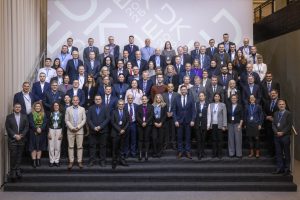 During the conference a key intervention was made by Tomas Orlickas, Deputy Director of the National Paying Agency (NPA) of Lithuania: “Research and development activities for more effective implementation of Lithuania’s CAP Strategic Plan” In his presentation, Tomas Orlickas highlighted Lithuania’s comprehensive contribution to the EU-funded research, development, and innovation initiatives designed to strengthen the implementation of the CAP Strategic Plan and support the transition towards a more sustainable, modern, and data-driven agricultural sector. The Deputy Director presented Lithuania’s ongoing research and innovation initiatives aimed at improving the efficiency, accuracy, and strategic coherence of the country’s CAP Strategic Plan implementation.
The Deputy Director also pointed out that the NPA’s Research & Development activities are closely aligned with EU priorities for digital transformation, environmental performance, transparency, and administrative efficiency. Tomas Orlickas outlined the importance of environmental monitoring, modelling of agricultural practices and tools that help measure biodiversity, carbon impacts and land-use changes, that are essential for delivering the green architecture of CAP. The showcased key initiatives included a number of projects with a focus on GFarm being among them.
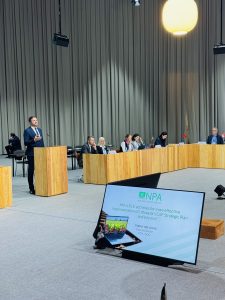 The Gfarm for Life initiative – together with ESA GTIF and related carbon and GHG monitoring work – aims to design, test, and validate reliable methods for assessing and reporting greenhouse gas (GHG) balances in agriculture, forestry, and other land-use sectors (AFOLU). Key activities include:
- Creating the foundations for a national carbon-sequestration certification scheme, including the technological infrastructure, carbon registry platform, and mechanisms for data exchange and governance.
- Working with policymakers and sector stakeholders to update national GHG accounting approaches, regulatory frameworks, incentive structures, and role assignments.
Project tasks cover the development of methodologies, calculation tools, carbon mapping, as well as demonstrations, training sessions, and e-learning resources. The initiative will establish a system for monitoring soil organic carbon stocks, support the rollout of a carbon certification and monitoring framework, and deploy digital tools that help farmers operate more efficiently while contributing to EU climate-neutrality targets.
Within the project, the NPA is contributing to the development of a free carbon-credit platform, designed to simplify farmers’ participation and enable them to earn additional income. By providing access to open-source data, the project encourages broader farmer involvement and facilitates their ability to benefit from carbon credits.
The presentation was followed by a Q&A session, allowing other Paying Agencies to explore how similar innovation-focused approaches could strengthen CAP implementation across the EU. Overall, the conference underscored a shared commitment among EU Paying Agencies to modernisation, interoperability, and innovation, setting the stage for enhanced collaboration.
Shaping Climate-Smart Land Management: Reflections from Our Carbon Credits Workshop
At this year’s AgriFood Forum ’25, our team stepped into one of the most urgent conversations shaping the future of food systems and land use: the evolving role of carbon credits in agriculture and forestry. As the transition toward climate-smart practices accelerates across Europe, the question is no longer if land-based carbon markets will influence agriculture and forestry, but how we prepare ourselves to meaningfully participate in them. This is the question our panel and workshop set out to explore.
During the Forum, we led the panel “Carbon Credits in Agriculture and Forestry: From Brussels to Lithuanian Fields”and followed it with an interactive, hands-on workshop. The combination attracted a diverse audience: farmers, foresters, agribusiness leaders, NGOs, certification specialists, academics, and public-sector representatives — each with a unique stake in how carbon markets evolve.
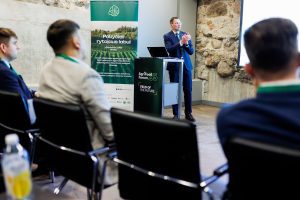 The goal was simple: bring people together to translate EU-level policy discussions into practical, on-the-ground perspectives. The interactive workshop created space for honest dialogue about what carbon credits mean for Lithuania’s landowners and businesses — not in theory, but in day-to-day practice. Participants worked through questions such as:
- How can agricultural and forestry practices be measured as verifiable climate services?
- What does it take for a soil or forest management improvement to qualify for a carbon credit?
- Which certification schemes are trusted, and what do they require?
- How ready are companies to buy land-based credits, and what are they looking for?
What emerged was a shared realisation: carbon credits are not a future vision — they are already reshaping supply chains, investment decisions, and land-use strategies across Europe. Lithuania has a strategic opportunity to position itself well, but only with coordinated action.
The conversations at AgriFood Forum ’25 made one thing clear: Lithuania has a strong foundation for becoming a frontrunner in climate-smart agriculture and forestry. With its scientific expertise, digital readiness, and increasingly engaged landowners, the country is well-positioned to shape credible, transparent, and competitive carbon market solutions.
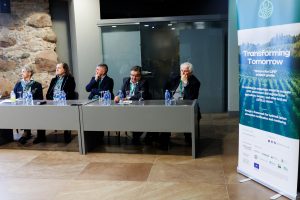 But success requires coordinated effort — across sectors, ministries, science institutions, and communities. The Forum discussions were an important step in building this shared understanding.
Carbon credits are often discussed as a technical topic, full of terminology and requirements. But at their core, they are about how we value land, how we support the people who manage it, and how we build systems that reward climate-positive action.
AgriFood Forum ’25 showed that Lithuania is ready to be part of this conversation — not as a follower, but as a contributor and leader.
GFarm Joins CRCF Methodology Development Workshop
The GFarm for LIFE team was proud to participate in the workshop organised within the project “Technical support for the development of carbon farming certification methodologies”, commissioned by DG CLIMA to Wageningen University & Research.
The workshop brought together a wide range of EU-funded initiatives to explore how ongoing research can support the development of certification rules under the new CRCF Regulation.
GFarm for LIFE contributed insights on how integrated monitoring, improved forest management practices and harmonised data systems can help build robust, transparent and resilient carbon-farming methodologies.
During the discussion, the team presented how GFarm’s national-scale MRV approach: combining field data, remote sensing and existing national datasets - can strengthen the evidence base for CRCF implementation. The project demonstrated which improved forest management practices are most effective for increasing long-term carbon removals and boosting ecosystem resilience, including closer-to-nature forestry techniques, enhanced structural diversity, longer rotations and selective harvesting.
GFarm also highlighted the importance of including all major carbon pools: living biomass, deadwood and soils, to avoid trade-offs and ensure realistic accounting. The project further emphasized the need to integrate climate-driven disturbance risks such as drought, fire, storms and pest outbreaks into business-as-usual baselines so that potential carbon benefits are not overstated.
As discussions turned toward baseline approaches, GFarm advocated for regionalised, standardised baselines grounded in existing data systems and complemented by project-specific measurements when necessary. This hybrid approach balances accuracy, comparability and practicality - key principles for CRCF.
Finally, the team showcased how the project’s monitoring tools, data harmonisation efforts and pilots of climate-smart practices contribute to minimum sustainability safeguards, support DNSH compliance and ensure that carbon-farming actions deliver co-benefits for biodiversity, soil health and water retention.
Overall, the workshop provided an excellent opportunity to share GFarm’s progress and learn from fellow EU projects working toward the same goal: building credible, science-based and user-friendly methodologies for future carbon-removal certification across Europe.
EC representative: NPA is an example to follow
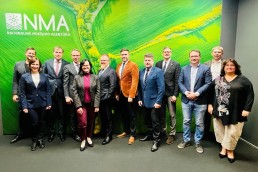
Last week Oliver Sitar, Director of the European Commission’s (EC) Directorate-General for Agriculture and Rural Development (DG Agri), accompanied by representatives of the EC agricultural and rural development policy sector, and of the Ministry of Agriculture, visited the National Paying Agency (NPA) in Lithuania.
The purpose of the visit to the NPA was to familiarise with the institution’s key processes, the principles of EU support administration and monitoring. The EC representative was particularly interested in the NPA as an organisation with its 26 years of experience, annually paying out around 1 billion euros of the EU support to the agricultural sector. In his presentation, NPA Deputy Director Tomas Orlickas explained how the agency’s knowledge and experience have been accumulated, applied and improved on a regular basis, thus shaping the unique history of the NPA’s activities. He also outlined the innovative tools that are actively implemented and used, as well as their benefits and future prospects. The NPA Deputy Director also highlighted the role of international projects with the participation of the NPA. These initiatives play a significant role in further development, testing and introduction of innovations in the daily activities of the institution.
Among the highlighted projects – EU LIFE programme Green Farm for LIFE / ESA GTIF / Carbon & GHG Monitoring (Area Monitoring & Carbon Credits System). The purpose of the project – to develop, pilot and validate accurate assessment and reporting of greenhouse gas (GHG) balances in agriculture, forestry, and land use (AFOLU). The project activities include:
- Designing frameworks for a national carbon absorption certification system, developing technological infrastructure, carbon register / platform, and data exchange / governance;
- Engaging policymakers and stakeholders to adapt national GHG assessment, regulatory needs, incentive systems, and responsibilities.
The project tasks include creating methodologies, calculation tools, carbon maps, demonstrations, training, and e-learning. The project will develop a system for monitoring soil organic carbon storage, fostering a carbon absorption certification and monitoring framework, and implementing digital tools for farmers to improve efficiency and contribute to EU climate neutrality goals. Within the scope of the project, the NPA contributes to developing a free carbon credit platform that will make it easier for farmers to earn additional income. By getting access to open-source data, farmers will be encouraged to participate and benefit from carbon credits.
The guest was especially impressed by the advanced remote monitoring tools that are used and continuously developed by the NPA and expressed his positive view on their further elaboration. This area attracted significant interest and numerous questions from the visitors regarding both the current benefits of these tools – ensuring the quality, efficiency, convenience and reliability of inspections – and their future perspectives. EC representative Oliver Sitar noted that the NPA’s operations and certain processes, particularly inspections, deserve attention across Europe, and that innovative technologies, such as satellite-assisted optimisation of monitoring, should serve as an example for institutions working in the agricultural sectors of other EU Member States. He expressed a firm position that the dialogue between the NPA and EC representatives should continue.
Oliver Sitar’s visit to the NPA was an important part of his broader mission to gain first-hand insight into Lithuania’s agricultural sector, with the aim of ensuring a fair and robust future for the EU Common Agricultural Policy and support conditions in the 2028–2034 financial perspective. The visit was organised by the EC Representation in Lithuania, in cooperation with the Ministry of Agriculture.
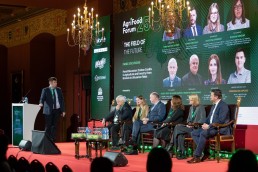
From Brussels to Lithuanian Fields: How Carbon Credits Are Shaping the Future of Agriculture and Forestry
As the European Union accelerates its transition toward climate neutrality, farmers and foresters increasingly find themselves at the center of the discussion. Their lands - our fields and forests - hold some of the strongest potential to remove carbon from the atmosphere. But how will this potential be measured, certified, and rewarded? And what does the new EU Carbon Removals and Carbon Farming Regulation (CRCF) mean in practice for Lithuania and the wider Baltic region?
These were the driving questions behind the international initiative GFarm for Life, which hosted a dynamic panel discussion titled “Carbon Credits in Agriculture and Forestry: From Brussels to Lithuanian Fields.” The event brought together EU experts, national policymakers, and practitioners navigating the rapidly evolving carbon farming landscape.
Setting the Scene: EU Pathway to Climate Neutrality
The keynote presentation was delivered by Christian Holzleitner, Head of Unit for Land Economy and Carbon Removals at the European Commission’s DG CLIMA. His intervention provided clarity on where Europe stands today - and where it aims to be within the next three crucial years.
Ch. Holzleitner outlined the EU’s pathway to climate neutrality, highlighting the essential contribution of carbon removals and the need for robust, science-based certification. Under the CRCF Regulation, Europe is laying the groundwork for a transparent system that can reliably measure and verify carbon removals generated by farmers, foresters, and landowners. A few priorities stood out from his presentation:
- Launching the EU market for carbon farming credits – a structure that will allow farmers and foresters to voluntarily enter the system and generate certified credits.
- Diversifying demand – not only from food and biomass processors within the value chain, but also from actors outside it, such as corporate buyers committed to net-zero targets.
- The emergence of the EU Buyers’ Club – an initiative expected to create coordinated, trustworthy demand for high-quality carbon removal credits.
- Clearer guidance coming soon – with the next three years set to define methodologies, monitoring rules, and operational models for large-scale adoption.
Together, these developments signal that carbon farming is shifting from experimental projects to a structured and regulated market opportunity.
A Regional Conversation With European Relevance
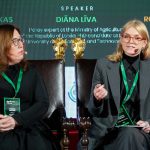
Following the keynote, an outstanding panel of experts explored how these European developments translate into national policies and concrete actions on the ground. The panel brought together: Tomas Orlickas – National Paying Agency (Lithuania), Krystyna Springer – Institute for European Environmental Policy (IEEP), Rovena Grikienė – Ministry of Agriculture of the Republic of Lithuania, Algis Gaizutis – Forest and Land Owners Association of Lithuania (FOAL), Diāna Līva – Ministry of Agriculture of the Republic of Latvia, Eimantas Pranauskas – Lithuanian Association of Agricultural Companies. Moderated by: Romualdas Lapickis (AgriFood Lithuania)
The conversation surfaced a shared understanding: carbon farming and removals offer significant environmental and economic opportunities, but only with clear rules, effective monitoring, and stable incentives. Among the key themes discussed were:
- How national administrations are preparing to implement the CRCF framework.
- The readiness of farmers and foresters to participate in voluntary carbon markets.
- The importance of building trust: transparency, verification, and long-term certainty for credit buyers.
- The unique Baltic perspective, including cross-border collaboration and shared ecosystem challenges.
Why This Discussion Matters
Carbon farming is more than a policy tool—it is becoming a new economic activity that can reward land managers for practices that enhance soil health, increase carbon sequestration, and support biodiversity.
For Lithuania and neighboring countries, this shift offers both opportunities and responsibilities: Opportunities to attract investment, strengthen rural economies, diversify farm income, and scale nature-based solutions. Responsibilities to ensure land practices are sustainable, measurable, and aligned with broader climate objectives.
The GFarm for Life discussion highlighted that success will rely on cooperation across sectors—policy, science, farming communities, and industry.
Moving Forward
As Europe enters a new phase of climate action, the agriculture and forestry sectors have a chance to lead. With the CRCF Regulation setting the rules, and demand for carbon removals growing rapidly, farmers and foresters can become essential partners in delivering climate neutrality. Events like this one - bridging Brussels and Lithuanian fields - play a crucial role in ensuring that the transition is informed, inclusive, and grounded in real-world experiences.
Gfarm at AgriFood Forum’25: Turning Carbon Ambition into Action
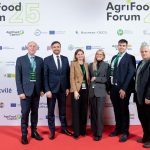
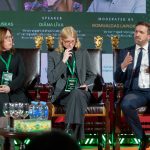
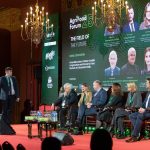
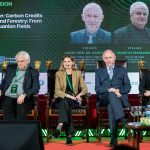
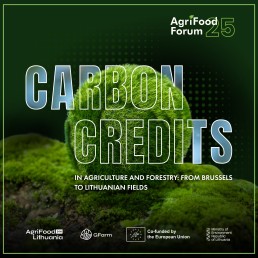
On Wednesday, November 26, the Gfarm team will take part in AgriFood Forum’25, held at the historic Palace of the Grand Dukes of Lithuania in Vilnius. As part of the programme, Gfarm will host a panel discussion titled “Carbon Credits in Agriculture and Forestry: From Brussels to Lithuanian Fields”, focusing on one of the most pressing and promising topics for the future of land use and sustainability.
The panel aims to bridge the gap between European-level policy development and the realities of local implementation. While carbon markets and climate regulations are often shaped in Brussels, their real impact is felt on farms, in forests, and across rural landscapes. This discussion will explore how EU ambitions around carbon sequestration, biodiversity, and climate neutrality can translate into practical, measurable outcomes for Lithuanian farmers and forest managers — as well as new economic opportunities for the wider agricultural sector.
Following the panel, participants will be invited to take part in a hands-on workshop, “From Soil to Market: Carbon Credits and Sustainability.” This interactive session is designed to go a step further, turning theory into practice. Farmers, forest managers, agribusiness leaders, and sustainability experts will come together to examine how land-based carbon credits can reshape land use practices, support more sustainable management, and become a tangible part of business and climate strategies.
The workshop will also address how agricultural and forestry activities can evolve into measurable, verifiable, and tradable climate services. In addition, it will showcase how forward-thinking companies are beginning — or are already — to integrate carbon credits into their sustainability commitments and supply chain models.
AgriFood Forum’25 promises to be an important meeting point for those shaping the future of food systems, land use, and climate action in Lithuania and beyond. The Gfarm team looks forward to engaging in meaningful discussions and working together to build more sustainable solutions for our landscapes and our communities.
Will you be joining the conversation?
The full agenda of the event: https://www.digitalfarm.lt/