

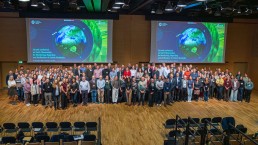
Lithuanian experts participated in an international conference on the application of Earth observation technologies for carbon accounting
The latest Earth observation technologies used for climate change monitoring and carbon dioxide removal accounting were discussed at a conference held in Copenhagen on October 7–10. Lithuania was represented at the event by Marius Balčius and Ernesta Ažukaitė, senior specialists from the National Forest Inventory Division of the State Forest Service (VMT), and Martynas Rimgaila, advisor to the Direct Support Control Division of the National Paying Agency.
The Second Conference on Earth Observation for Monitoring, Reporting, and Verification of Carbon Removals was attended by representatives of the European Commission, the European Environment Agency, and numerous governmental, non-governmental, and scientific institutions.
The event focused on how Earth observation technologies can contribute to improving monitoring, reporting, and verification (MRV) systems, land use, land-use change, and forestry (LULUCF) sector accounting, and the implementation of European climate policy objectives.
"Events like this empower the exchange of experiences and strengthen the capacity of national institutions to use spatial data for climate policy implementation and carbon accounting," says Marius Balčius, Chief Specialist at the National Forest Inventory Division of the State Forest Service.
The conference shed light on the latest research and projects related to satellite data, laser scanning (LiDAR), and other Earth observation methods used in preparing greenhouse gas (GHG) inventories for the LULUCF sector.
From 2027, all EU Member States must monitor land use changes in the LULUCF sector using geographic data, as provided for in the adopted LULUCF Regulation No. 2018/841. The topics discussed at the conference reflected the direction of research and scientific work being carried out in Lithuania. The knowledge gained and experience shared with representatives of other countries allowed us to assess the relevance of our work and confirm that our efforts are heading in the right direction in improving LULUCF GHG inventory accounting.
Draft versions of the Carbon Removal Certification Framework (CRCF) methodologies for carbon sequestration farming were also discussed.
During the event, the project GFarm, implemented in Lithuania and funded by the LIFE program, was presented. The project stand attracted the interest of participants, who were curious about the activities and expected results. Martynas Rimgaila, a representative of the National Paying Agency (NPA), one of the project partners, presented the agricultural part of the project, while representatives of the VMT presented aspects of the project related to forests and their potential in the field of carbon certification.
Experts from EU countries discussed how spatial data can help increase transparency, reliability, and comparability among countries implementing climate commitments.

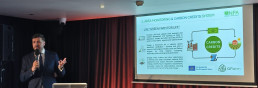
Lithuania hosts the 24th Conference of the Baltic and Polish Paying Agencies
On 24–26 September 2025, the National Paying Agency (NPA), Lithuania, invited the paying agencies of the Baltic States and Poland to the conference “Innovations and Technologies – the Driving Force of the Strategic Plan for Agriculture and Rural Development 2023–2027”. Agricultural progress, good farming practices, and the use of artificial intelligence in the paying agency activities were the main topics discussed by the conference participants this year.
The conference was dedicated to discussing current issues in the agricultural sector, innovations and sharing experience in support administration.
NPA Director Fortunatas Dirginčius welcomed the conference participants and emphasized that today, in the field of agriculture, when implementing the Strategic Plan for Agriculture and Rural Development of Lithuania 2023–2027 (Strategic Plan), many tasks are being taken over by robots and automated systems: “Modern methods of plant fertilisation, automated processes, innovations that allow monitoring farm activities and performing their analysis are no longer the future. Farmers are already using such tools today.”
The presentations delivered during the conference included those by NPA’s Director presenting digital solutions in implementing the Strategic Plan, by the Control Department Director on ALNSIS 1.0 and 2.0 regarding control and administrative systems, followed by presentations of the Latvian paying agency representative about shared Earth Observation platforms, insights from private innovation providers (on image classification, Sentinel-2 image use). Representatives of paying agencies from Estonia and Poland held discussions on the digital and information technology solutions used in their activities and stressed their importance in administering support measures.
In addition, during the conference a cooperation agreement was signed with the Polish Paying Agency (ARMA). A particularly relevant topic was discussed too – the conclusion of the 2014–2020 Rural Development and Aghriculture programming period. Conference participants shared the challenges they are facing and looked for ways to overcome them.
Active and meaningful discussions with colleagues from the Latvian, Estonian, and Polish paying agencies were especially valuable in seeking joint solutions on how to improve the support administration process and ensure smooth and high-quality agency work.
The presentation delivered by the NPA Deputy Director Tomas Orlickas focused on the NPA’s international projects, the interplay of support measures under the Strategic Plan, and lessons learned through its implementation. The international projects were presented as elements integrated in an overall digital ecosystem that includes parcel delineation, crop classification, and remote sensing, supporting Lithuania’s CAP Strategic Plan and more biodiversity-sensitive agricultural policy. In his presentation the NPA Deputy Director also focused on the international projects as part of a wider area modeling and monitoring system being developed by the National Paying Agency, highlighting the EU LIFE Programme Green Farm for LIFE project among them:
EU LIFE programme Green Farm for LIFE / ESA GTIF / Carbon & GHG Monitoring (Area Monitoring & Carbon Credits System) – with its purpose to develop, pilot and validate accurate assessment and reporting of greenhouse gas (GHG) balances in agriculture, forestry, and land use (AFOLU). The project activities include:
- Designing frameworks for a national carbon absorption certification system, developing technological infrastructure, carbon register / platform, and data exchange / governance.
- Engaging policymakers and stakeholders to adapt national GHG assessment, regulatory needs, incentive systems, and responsibilities.
The project tasks include creating methodologies, calculation tools, carbon maps, demonstrations, training, and e-learning. The project will develop a system for monitoring soil organic carbon storage, fostering a carbon absorption certification and monitoring framework, and implementing digital tools for farmers to improve efficiency and contribute to EU climate neutrality goals. Within the scope of the project, the NPA helps to develop a free carbon credit platform that will make it easier for farmers to earn additional income. By getting access to open-source data, farmers will be encouraged to participate and benefit from carbon credits.
Representatives of agencies from Estonia and Poland held discussions on the digital and information technology solutions used in their activities and stressed their importance in administering support measures.
In addition, during the conference a cooperation agreement was signed with the Polish Paying Agency (ARMA). A particularly relevant topic was discussed too – the conclusion of the 2014–2020 Rural Development and Aghriculture programming period. Conference participants shared the challenges they are facing and looked for ways to overcome them.
Active and meaningful discussions with colleagues from the Latvian, Estonian, and Polish paying agencies were especially valuable in seeking joint solutions on how to improve the support administration process and ensure smooth and high-quality agency work.
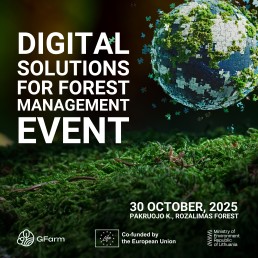
Interactive Field Demo and Networking Opportunity in Rozalimas Forest (Pakruojis) – 30 October
Forests are becoming smarter. With the help of digital technologies, we can now monitor forest health, assess sustainability, and make better management decisions faster and more accurately than ever before. To bring these innovations closer to practice, the GFarm project is organising an interactive field demonstration and networking event on 30 October in Rozalimas Forest, Pakruojis.
Co-organised by AgriFood Lithuania, Beta via, and Melda, the event will gather forestry professionals, researchers, and technology developers to explore how digital tools can support sustainable forest management and strengthen the green transition.
Throughout the day, participants will have the opportunity to see innovative digital solutions in action and discuss how technology can make forestry more data-driven, efficient, and environmentally responsible.
Event Programme
10:00 – 10:30 Registration and coffee
10:30 – 10:40 Welcome remarks (Meldas Lampickas, UAB MELDA)
10:40 – 11:00 Test before invest – live demonstration: data collection using thermal and hyperspectral cameras (Jonas Pakaušis, BetaVia)
11:00 – 11:20 How digital technologies are transforming forest infrastructure planning (Dr. Sonata Grabusovė, BetaVia)
11:20 – 11:40 Satellite-based forest sustainability in the GFarm initiative (Romualdas Lapickis, AgriFood Lithuania)
11:40 – 12:30 The ICAERUS digital tool for business model analysis and decision-making (Linas Didžiulevičius, BetaVia)
12:30 – 13:00 Questions, answers, and networking
The GFarm field demo in Rozalimas Forest is more than just a showcase of technology – it is an opportunity to connect with experts who share a vision of a more sustainable and innovative forestry sector. Participants will gain valuable insights into practical applications of digital tools, from real-time data capture to strategic planning and sustainability assessment.
Participation is free of charge, but registration is required. Register here: https://lnkd.in/eKCRDVaJ